Netflix to face acid test in Q2′ 2020

People have been telling me for years now that Netflix is the next big thing and will change the entertainment world forever.

As much I loved the product (digital streaming platform showing latest flicks catering to audiences of all ages and tastes), I got curious to understand its business model.

Unfortunately, it did not take me long to feel disappointed. Business experts called me an “Old world” thinker.

But whatever the thought process may be, I don’t know what else could be the primary objective of a business other than to earn cash flows for it’s owners (sooner or later).

The meteoric rise of Netflix warped the media industry forcing companies like Disney and AT&T to embrace a business model that is fundamentally broken: Spend billions of dollars to create an endless supply of content, then sell monthly access to this deluxe all-you-can-eat buffet for little more than the cost to have dinner at McDonald’s.

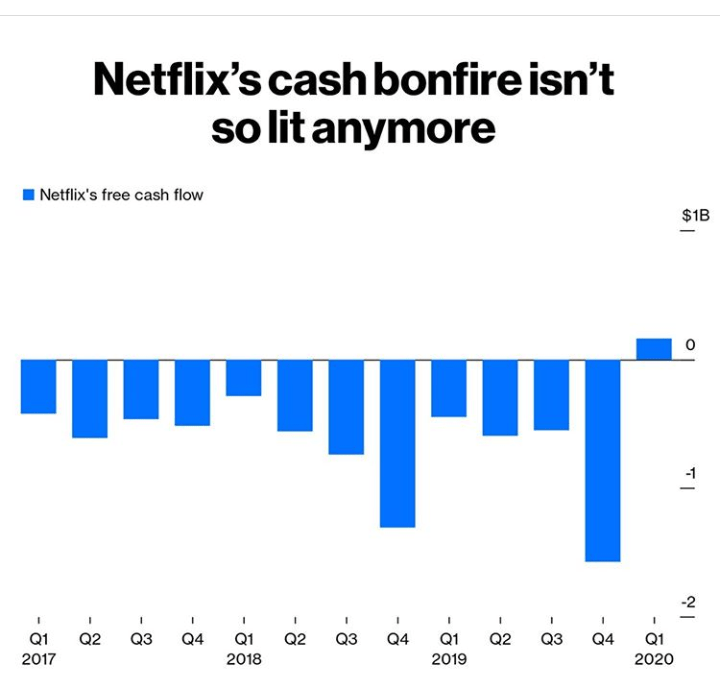
Netflix is debt ridden and is burning cash like any thing. Oddly enough, with Hollywood / Bollywood on hiatus, Netflix’s content costs have been pushed off, creating an unusual instance of positive cash flow.

But the question is once the lockdowns are lifted, will the cash flows hold?

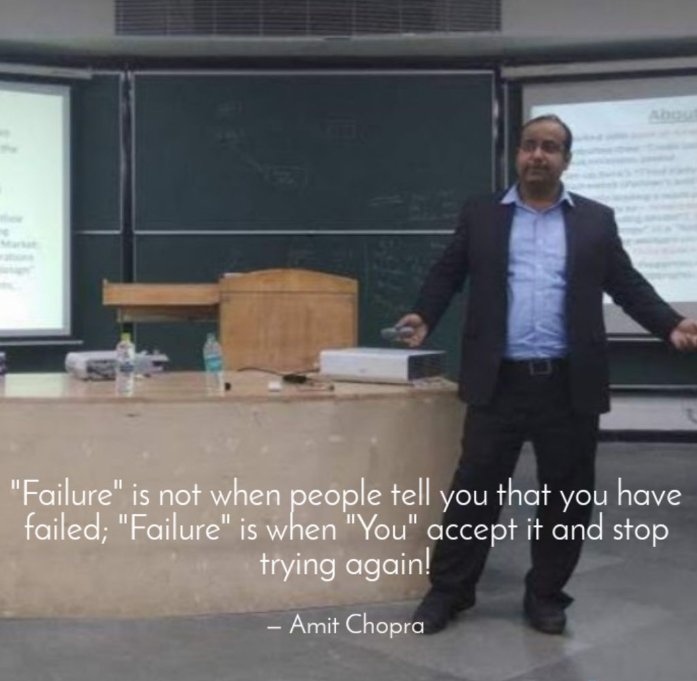
Amit Chopra, Business Consultant, IIM KASHIPUR

Will Covid -19 change Consumer behavior permanently?

The Covid-19 pandemic has created a dramatic change in the way we were leading our lives. People have completely transformed the ways they work, eat, learn, buy, and engage socially. In India, we are cooking and eating most of our meals at home, our screen time (TV and mobile) has increased, and we are connecting more with our friends and family. Other changes include a spike in animal adoption and baking activities in the US. In times of social isolation, uncertainty and fear, food, family, and pets can lead to feelings of enhanced comfort and security.

But how many of these behavioral changes are we likely to sustain after the pandemic ends?
The lockdown has forced us to slow down mentally. Some of us who have the luxury of assured livelihoods and the purchasing power has suddenly found time to ponder and introspect. Ordinarily, self-reflection fosters self-insight and is an essential ingredient in self-knowledge. Maybe this self-reflection compels us to rethink who we are as individuals and as a society, leading to some permanent changes in the way we consume. Compared to our busy and frenzied lifestyles, we now have a flexible schedule, chores that can wait, and quieter moments. Moreover, we face logistical constraints on the supply side. These factors have already led us to make modifications in the way we consume products and interact in the marketplace.

Some interesting trends have emerged as consumers are reconsidering their consumption sources and re-negotiating their communication modes. First, consumers have become increasingly sensitive to their health and are making behavioral changes to protect and enhance their well-being. Second, they are exploring new modes of interactions to engage and connect with each other and the marketplace.

Wellness, Organic & Local Products: The pandemic has put health and wellness in the center of our thoughts, actions, and lives. Wellness, as a category, was witnessing favorable growth even at times when consumers were making fewer discretionary purchases. It seems that this growth will sustain in times to come, and it is likely to remain an essential area of consumption for many. Pharmaceutical companies like Himalaya, e-marketplaces such as Grofers and Milkbasket, as well as new-age ayurvedic health brands like Auric, have seen a surge in sales in immunity tablets and herbal teas. Spending on wellness products provides one way to the consumers to be proactive amidst the uncertainty. COVID-19 has reminded consumers of the frailties of our public health system. That is something that is not in our control, but spending on wellness transfers some psychological control back to the consumer. A recent consumer sentiment survey by McKinsey showed how the Chinese consumers were beginning to spend on fitness and wellness, apart from necessary expenditures.

With health at the center of consumer’s consumption decisions, organic foods might have more appeal. The consumption of these foods has been increasing in the past few years. Even the 2008 financial crisis could not dampen its growth in the US. The pandemic may, if anything, accelerate its growth as consumers perceive them to be more nutritious. However, the economic downturn does pose risks where consumers might be forced to shift to cheaper options due to declining incomes and supply-side constraints.

With the lockdown, locally produced products and shops have become a necessity. The lockdown has made many consumers rely on their local kiranas, which have emerged as bastions of their residential communities. These local stores understand the consumer needs better and can respond with quicker and more singular actions. One of the new normal might be that consumers might also want to continue to consume products that are local and come from local shops. Even before the Covid-19 outbreak, a Nielsen survey found that 11% of global consumers said they only bought products manufactured in their country while an additional 54% “mostly” bought local products. There is evidence in the consumer psychology literature that shows that closer a product is to the source of its origin, higher is its perceived value or favorability in the minds of the consumer. COVID-19 could change consumers’ preferences for locally sourced and delivered products.

Since the pandemic has put health on the front end, it seems that consumption wellness, organic, and local might witness a “new normal.”

Health Insurance: Often, uncertainty and negative emotions lead consumers to defer decisions. However, fear is one of those discrete emotions that drives consumers to act and pay attention to the options available. We see firms trying to leverage consumer emotions in these uncertain times and highlight and the need to have health insurance, with the hope of consumer action in the form of enrollment to health plans. Health insurance player, Max Bupa has launched an integrated campaign #IgnoreNahiInsureKaro, as an advisory to consumers to stop giving excuses for not getting health insurance, and instead give their health the security it deserves. In the last few weeks, we have increasingly witnessed how the migrant, daily wage, and informal sector workers have struggled. The sensitivity to their struggles may lead to growth in startups (e.g., Gigibenefits), which aim at providing health insurance and small saving options to domestic/informal workers. Both small employers and informal sector employees may see value in investing in such products. Overall, we will probably see a rise in health insurance subscriptions.

Digital Media: With physical and spatial distancing, people are staying in their homes away from offices, schools, restaurants, malls, movies, and concerts. Gatherings and events have been canceled for the foreseeable future. This social isolation is against our nature, and so we have witnessed a surge in the use of digital mediums to connect and interact. Consumers’ engagement with digital media has drastically shifted. Rural India saw a 100% spike in data consumption during the beginning of the lockdown period. The number of subscribers for fiber to the home has also seen a surge. Such increases are also seen in urban spots with an increase in work from home options. 

The next automatic question is, what are Indians doing online? Consumers are actively searching for courses offered digitally. Schools and universities have moved online with virtual classes. Delhi Government is in talks with Khan Academy to provide online classes for class 12 students. Consumers are also going online for cooking recipes, fitness videos, and gaming. Apps such as Zoom and Houseparty have become common nomenclature. Even digital novices (older consumers) are exploring newer technologies and apps. Overall, there have been some interesting changes in behaviors as consumers navigate online.

Telemedicine: Mostly, consumers have valued physical or face-to-face interactions with their physicians as they have the lay beliefs that these involve more effort, richer social cues, and higher stakes. While in lockdown, panicked Indians searched for options to seek medical advice on COVID related symptoms. They realized that they did not need an actual face-to-face visit to a doctor’s office and made the complex transition from face-to-face interactions with their physicians to telemedicine. Startups like Practo, Portea, and Lybate, which facilitate remote medical checkups online and via phones, are witnessing substantial traffic increases. The surge in traffic for telemedicine made the government swiftly release new guidelines for telemedicine. With the consumers already exploring virtual and online options, these times provide an opportunity for firms to make these virtual medical interactions seamless and almost mirror physical visits so these trends do not decrease and consumers sustain their positive attitudes towards these virtual interactions even after the crisis. Diabetes care and management app BeatO is trying to emulate the real-life experience by giving patients the option of adding their regular doctor to the platform.

Digital Banking and Online Payments: Further, the reduced physical access to banks has also moved consumers towards online banking and the use of digital wallets to transfer money. The shift towards these options may sustain even after the lockdown ends. Not just consumers, we will also see brick-and-mortar local retailers accelerate technology adoption. Players like Flipkart and Zomato are already partnering with these local stores to deliver efficiently. The small retailers will likely use the current momentum to ramp up the use of technology to deliver at home and expand online payment choices. 

While some of these trends may plateau or not see such a steep rise once the lockdown ends, what will remain and evolve is the way the Internet is leveraged in our daily life to interact with each other for learning, work, shopping, and so on.

What we hope will change for the better? This temporary pause has given us time to be intimately aware of our good and bad and probably seek our ideal selves that is closer to nature, more pro-social, and connected to society. There is an emerging discussion about living in more harmonious ways with the earth. We are currently witnessing a massive drop in pollution levels. Maybe we emerge greener, cleaner, and more altruistic. However, pollution drops in the previous crises such as World War II, the Great Depression, and the 2008 economic crisis were followed by a significant spike in emissions. Maybe this pause is merely as temporary as the previous ones. Human memory is often fleeting. Things are forgotten and relegated to oblivion, which allows us to move forward. However, our onward journey becomes meaningful only when we embrace some lessons from past crises.We hope that this crisis is different and that it will create a “new normal”- a normal that is more sustainable and equitable. Once the economy bounces back, even though we might drown again in our busy schedules, we consciously decide to steer away from the ‘pre-COVID’ normal. We hope that this time we have a story to share of how we rebuild an economy that was more humane and connected.

RBI rate cuts!!!

You can take a horse to water, but you cannot make it drink. This is an old saying, so old that people who have not touched a horse in their real life, leave alone tried to make it drink water, constitute the vast majority of humanity, particularly that elite chunk of it that inhabits the Reserve Bank of India. Perhaps this explains why RBI honchos keep at their equine exertion with nary a lick’s worth of dip in the water level in the trough.

The RBI recently announced four liquidity measures and four regulatory changes intended to help the Covid-19 hit economy, along with a prudential regulation barring dividend payments by banks till further notice: banks have to build up their capital buffers against bad loans that could pile up.

All the regulatory measures are welcome and will help companies and real estate developers. The liquidity measures are a mixed bag.

The cut in the reverse repo rate is effective admission that the earlier measure of making yet more liquidity available to the banks via its long-term repo operations (LTROs) and Targeted LTROs (TLTROs) have not been working. For those mystified by RBI jargon, a repo is a sale and repurchase operation. A bank sells a bond at a particular price to the RBI, gets cash in return, agreeing to repurchase the bond back at a higher price after a specific period. That difference in price over the time period in question — overnight, fortnight, three years — works out as a rate of interest. Reverse repo is when the RBI sells the bond to the bank, taking money from the bank, with assured repurchase at a higher price. Through reverse repo, the RBI takes in money from banks and gives them an assured rate of return. This is totally risk-free return and the lower it is, the greater the incentive for banks to lend their money to someone who will pay a higher rate of interest.

Banks have simply been putting money back with the RBI. On March 27, the RBI governor informed us that banks were putting money back into the RBI at a daily rate of Rs 2.86 lakh crore, instead of using the liquidity to make fresh loans to business. Between March 27 and April 14, the funds the banks have been putting back into the RBI has gone up to Rs 4.36 lakh crore a day. On April 15, this amount spiked to Rs 6.9 lakh crore. The RBI now hopes that lowering the return on the money parked with it via reverse repo will persuade banks to lend to industry and business. This is futile.

No one is going to start an investigation into why a bank chairman and managing director deployed money with the RBI, whereas lending to a company runs two risks: one, of the loan turning bad, and two, of some promotion-hungry busybody or someone with the knives out for you raising a quiet complaint about a kickback and the CBI starting an investigation into the banker’s motive for granting that loan, with the Enforcement Directorate chipping in with a moneylaundering charge. Public sector bank managers have no incentive to lend — their remuneration structure offers little incentive for performance — and lots of incentives for playing it safe. This must change, before pushing money to the banks works out as an effective way of pushing money to economic agents.

The second TLTRO, planned for Rs 50,000 crore, seeks to push money to non-banking finance companies (NBFCs). This is welcome. Especially as 50% of it is to go to the bonds issued by smaller NBFCs and microfinance institutions. These bodies know how to lend to small industry, and this step is bound to put liquidity in the hands of small and medium business more surely than the initial TLTRO.

The third measure of granting refinance worth Rs 50,000 crore to National Bank for Agriculture and Rural Development, Small Industries Development Bank of India and the National Housing Bank is sound. These agencies know how to push money to their target beneficiaries. The RBI would do well to push more money through these windows.

Raising the Ways and Means Advance limit for states is a welcome move. An even more welcome move would be for the RBI to directly subscribe to bonds issued by state governments. Yes, this does mean printing money, but it would keep state government borrowing costs low and give the states the spending power they need to provide relief to people in desperate need of it and to spend on healthcare and other urgent priorities even as their revenues tank and the flow of funds from the Centre shrivels up.

In fact, the RBI must pick up fresh bonds issued by the Centre as well, to keep interest rates low even as the government expands the fiscal deficit to give the economy the boost it badly needs.

The regulatory easing relates to easier asset classification, extension of the time period between a loan default and putting in place a resolution plan without having to make aprovisioning of 20% on that loan, reduction in the money a bank has to pre-empt on liquid government bonds to cover its cash outgo, effected by lowering the so-called liquidity coverage ratio, and an additional grace period of one year for the real estate sector to start selling built-up homes. All these are welcome.

The RBI horses around with incentives for banks to buy corporate bonds by offering to not force the banks to mark these bonds to the market, and treat them as being held to maturity. This is a disincentive for active trading. If one bank with a good trading desk makes good profits on corporate bonds, it wants the trading profits recognised, not put into some accounting cubbyhole because the traded bonds were supposed to be held to maturity.

Now that horses are truly obsolete as a mode of transport, the RBI should also stop getting mixed up about metaphors on taking a horse to water. It should directly buy corporate and NBFC bonds and kickstart an active market in bond markets.

Priorities for the World Economy in times of Covid 19

I want to begin by wishing my personal best to everyone—for you and your families’ health and safety during these difficult times.

Today we are confronted with a crisis like no other. Covid-19 has disrupted our social and economic order at lightning speed and on a scale that we have not seen in living memory. The virus is causing tragic loss of life, and the lockdown needed to fight it has affected billions of people. What was normal just a few weeks—going to school, going to work, being with family and friends—is now a huge risk.

I have no doubt that we will overcome this challenge. Our doctors and nurses are fighting it around the clock, often risking their lives to save the lives of others. Our scientists will come up with solutions to break COVID-19’s grip. Between now and then, we must marshal the determination of all—individuals, governments, businesses, community leaders, international organizations—to act decisively and act together, to protect lives and livelihoods.

The actions we take now will determine the speed and strength of our recovery. That will be the focus of the major world agencies like IMF and World Bank in the coming days.

Where We Stand: the Status of the Global Economy

First, let’s look at where we stand. We are still faced with extraordinary uncertainty about the depth and duration of this crisis.

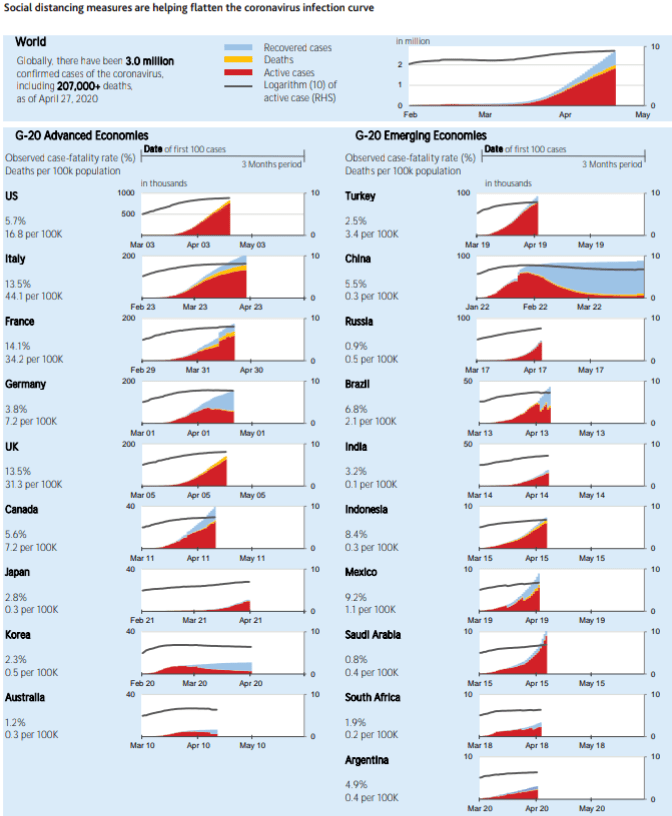
It is already clear, however, that global growth will turn sharply negative in 2020. In fact, I anticipate the worst economic fallout since the Great Depression.

Just three months ago, I expected positive per capita income growth in over 160 countries in 2020. Today, that number has been turned on its head: I now project that over 170 countries will experience negative per capita income growth this year.

The bleak outlook applies to advanced and developing economies alike. This crisis knows no boundaries. Everybody hurts.

Given the necessary containment measures to slow the spread of the virus, the world economy is taking a substantial hit. This is especially true for retail, hospitality, transport, and tourism. In most countries, the majority of workers are either self-employed or employed by small and medium-sized enterprises. These businesses and workers are especially exposed.

And just as the health crisis hits vulnerable people hardest, the economic crisis is expected to hit vulnerable countries hardest.

Emerging markets and low-income nations—across Africa, Latin America, and much of Asia—are at high risk. With weaker health systems to begin with, many face the dreadful challenge of fighting the virus in densely populated cities and poverty-stricken slums—where social distancing is hardly an option. With fewer resources to begin with, they are dangerously exposed to the ongoing demand and supply shocks, drastic tightening in financial conditions, and some may face an unsustainable debt burden.

They are also exposed to massive external pressure.

In the last two months, portfolio outflows from emerging markets were about $100 billion—more than three times larger than for the same period of the global financial crisis. Commodity exporters are taking a double blow from the collapse in commodity prices. And remittances—the lifeblood of so many poor people—are expected to dwindle.

I estimate the gross external financing needs for emerging market and developing countries to be in the trillions of dollars, and they can cover only a portion of that on their own, leaving residual gaps in the hundreds of billions of dollars. They urgently need help.

The encouraging news is that all governments have sprung into action and, indeed, there has been significant coordination. Countries around the world have taken fiscal actions amounting to about $8 trillion already. In addition, there have been massive monetary measures from the G20 and others.

Many of the poorer nations are also taking bold fiscal and monetary action, even as they grapple with this fundamental shock to their systems—and with far less firepower than their rich-country counterparts.

So this is a snapshot of where the global economy stands today.

There is no question that 2020 will be exceptionally difficult. If the pandemic fades in the second half of the year—thus allowing a gradual lifting of containment measures and reopening of the economy—my baseline assumption is for a partial recovery in 2021. But again, I stress there is tremendous uncertainty around the outlook: it could get worse depending on many variable factors, including the duration of the pandemic.

And crucially, everything depends on the policy actions taken now.

What Needs to be Done: a 4-Point Plan

My next point is about building the bridge to recovery. We see four priorities:

First, continue with essential containment measures and support for health systems. Some say there is a trade-off between saving lives and saving livelihoods. I say it is a false dilemma. Given this is a pandemic crisis, defeating the virus and defending people’s health are necessary for economic recovery. So the message is clear: prioritize health spending for testing and medical equipment; pay doctors and nurses; make sure hospitals and makeshift clinics can function. For many countries—particularly in the emerging and developing world—this means carefully reallocating limited public resources. It also means increasing the flow of resources to these countries. That includes the flow of vital goods: we must minimize disruptions to supply chains and, with immediate effect, refrain from export controls on medical supplies and food.
Second, shield affected people and firms with large, timely, targeted fiscal and financial sector measures. This varies according to country circumstances, but it includes tax deferrals, wage subsidies and cash transfers to the most vulnerable; extending unemployment insurance and social assistance; and temporarily adjusting credit guarantees and loan terms. Some of these measures have been taken in the first wave of policy support. Many countries are already working on a second wave. Lifelines for households and businesses are imperative. We need to prevent liquidity pressures from turning into solvency problems and avoid a scarring of the economy that would make the recovery so much more difficult.
Third, reduce stress to the financial system and avoid contagion. Banks in Developed countries have built up more capital and liquidity over the past decade, and their resilience will be tested in this rapidly changing environment. The financial system is facing significant pressures, and monetary stimulus and liquidity facilities play an indispensable role. Interest rates have been lowered in many countries. Major central banks have activated swap lines and created new ones to reduce financial market stress. Enhancing liquidity for a broader range of emerging economies would provide further relief. Importantly, it would also lift confidence.
Fourth, even as we move through this containment phase, we must plan for recovery. Again, we must minimize the potential scarring effects of the crisis through policy action now. This requires careful consideration of when to gradually ease restrictions, based on clear evidence that the epidemic is retreating. As measures to stabilize the economy take hold and business starts to normalize, we will need to move swiftly to boost demand. Coordinated fiscal stimulus will be essential. Where inflation remains low and well-anchored, monetary policy should remain accommodative. Those with greater resources and policy space will need to do more; others, with limited resources will need more support.

This leads me to the role of the World Agencies like IMF and World Bank.

These agencies are working 24/7 to support countries—with policy advice, technical assistance and financial resources:

— These agencies have $1 trillion in lending capacity and are placing it at the service of all countries.

— IMF and World Bank are responding to an unprecedented number of calls for emergency financing—from over 90 countries so far. Access to emergency facilities has been doubled, which will allow the agencies to meet the expected demand of about $100 billion in financing. Lending programs have already been approved at record speed—including for the Kyrgyz Republic, Rwanda, Madagascar, and Togo—with many more to come.

— Their research teams are reviewing the available tool kits to see how they might better use precautionary credit lines to encourage additional liquidity support, establish a short-term liquidity line, and help meet countries’ financing needs via other options—including the use of SDRs.

— They have revamped their Catastrophe Containment and Relief Trust to provide immediate debt relief to low-income countries affected by the crisis, thereby creating space for spending on urgent health needs rather than debt repayment. They are now working with donors to increase the CCRT to $1.4 billion to extend the duration of the debt relief.

Conclusion: A Test of Our Humanity

Let me conclude with a line from Victor Hugo who once said: “Great perils have this beauty, that they bring to light the fraternity of strangers”.

It is this common threat that brings us all together, to harness the greatest strengths of our humanity—solidarity, courage, creativity, and compassion. We don’t know yet how our economies and way of life will change, but we do know we will come out of this crisis more resilient.

Thank you very much
Design a site like this with WordPress.com
Get started